
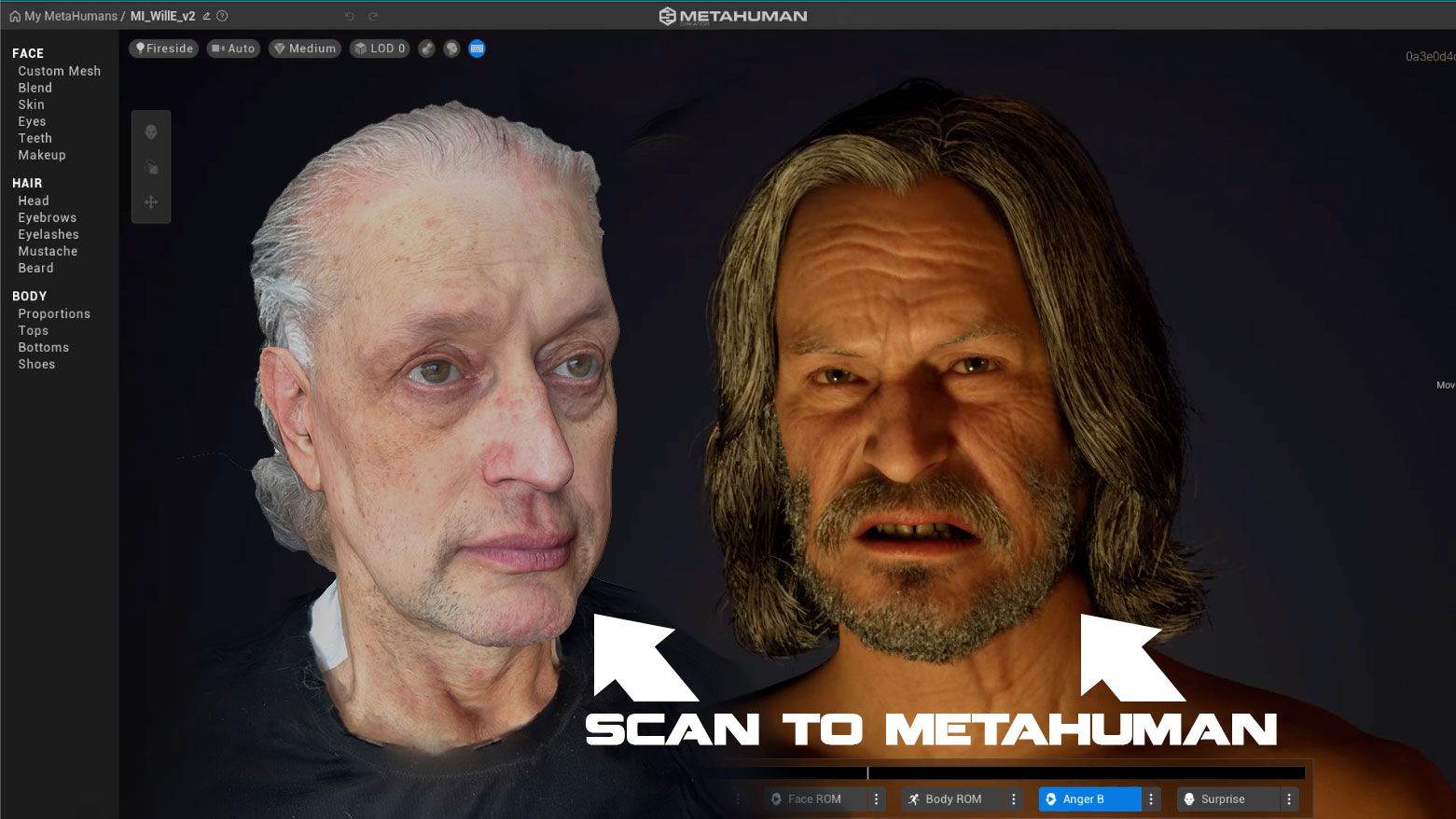
This is scanning of a human (if based of a real human actor) or the sculpting of a human if based off someone original or unattainable (dead?). Scan or scuplt is then prepared in 3D program (hair removed? sized) for the mesh-to-metahuman process. Next, the actor is pushed to the metahuman customizer to add skin, hair, eye color, etc.

To get a stronger likeness, a metahuman can be ‘re-baked’ – a process where an high resolution model is used as a morph target to reshape a previously created metahuman. The mesh-to-metahuman system loses many details that this ‘re-bake’ process (cinemotion patent pending) restores. Beyond that, there are special additions such as moles, scars and makeup effects added onto the above result.

Using a program called Marvelous Designer, special clothing is created in some cases from scratch, to fit on each specific metahuman. It works like traditional clothing design, from a sewing pattern that is digitally draped onto the character and then stitched together and simulated for hang, thickness, fabric type, friction and so on.

Traditionally, before a clothing item can be worn by a character, it need to be ‘weight painted’, a lengthy and tedious process where each metahuman bone is assigned to drive parts of the mesh of the clothing. It is a constant battle of values per bone, per vertex. With uDraper, though, the entire garment is simulated based on collisions with the metahuman wearing it. Weight painting is not applied here but the garments must be prepared using the uDraper plugin.